
Emma Lee
Jun 27, 2026
What Your Face Map Can and Cannot Tell You |
Welcome to another issue of Just About the Glow.
The newsletter for women simplifying skincare, buying more selectively, and finding their way back to healthy, steady glow.
If this helps, forward it to someone overwhelmed by skincare noise.
In this issue:
1. What a new Korean facial aging map found about wrinkles and pigmentation.
2. Why different facial regions may need different forms of care.
3. How to use the research without turning your routine into a treatment plan for every inch of skin. |
|

Trivia Question❓What popular K-Beauty ingredient is known for its anti-aging properties and is derived from fermented green tea leaves? Answer at the bottom of the newsletter |
|
Does Every Part of Your Face Age the Same Way? |
You've probably noticed that skin changes don't arrive evenly.
The eye area may look finer or less cushioned while the cheeks begin showing uneven tone. The forehead may still feel smooth. One side may seem more affected than the other.
That unevenness can make skincare feel confusing, especially when a product promises to address the whole face with one broad claim.
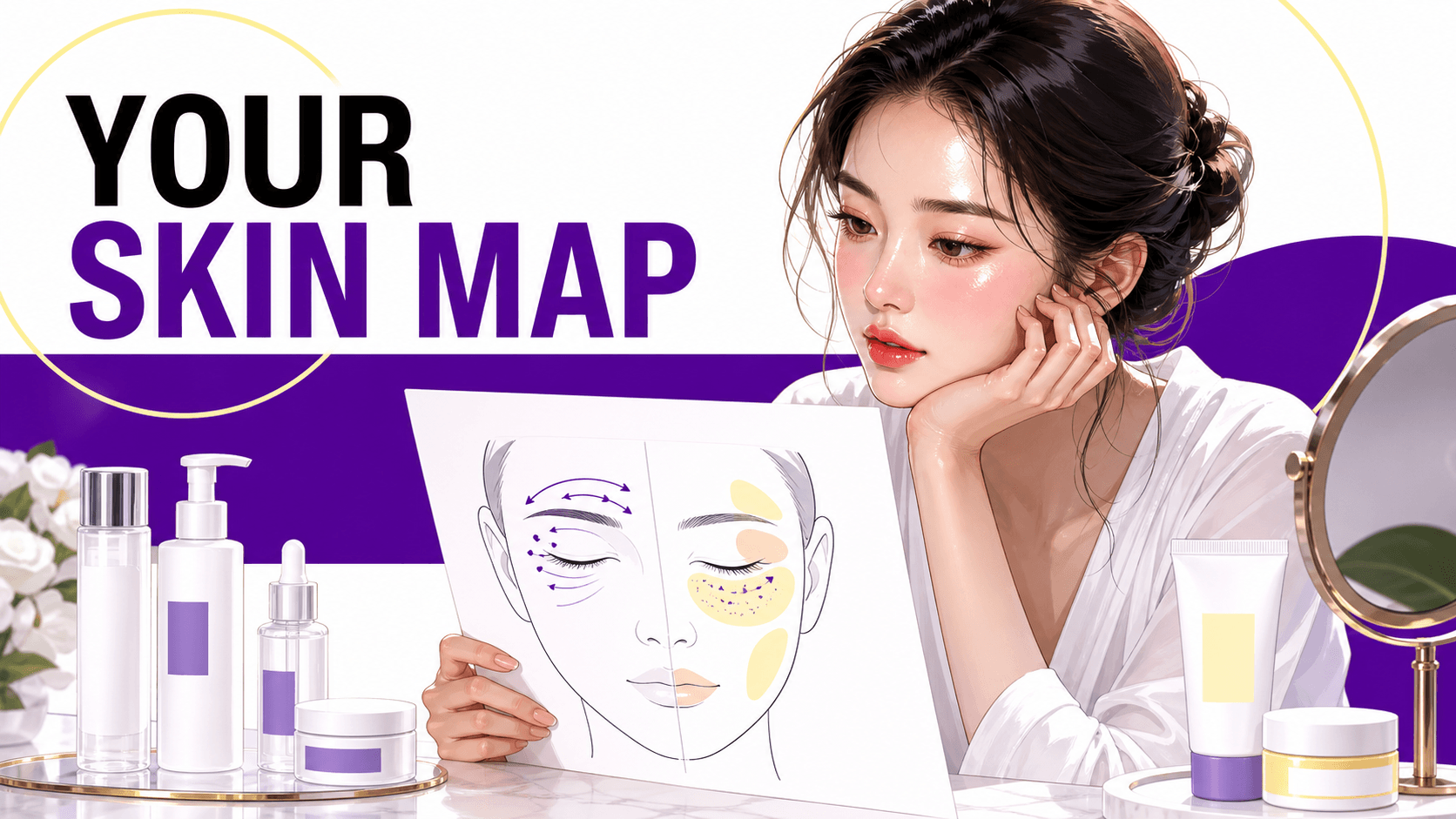
New research from Amorepacific offers a more specific way to think about it. The company's facial aging map suggests that wrinkles and pigmentation follow different regional patterns rather than progressing as one uniform process. |
|
The Starting Point |
Amorepacific presented the research at the ISBS World Congress on June 12, 2026.
The researchers used Korean facial datasets and standardized composite images to examine where visible changes tended to appear over time.
Wrinkles appeared first around the eyes, then spread toward areas influenced by repeated facial movement. Pigmentation appeared first across the cheeks and beneath the eyes before becoming more widespread.
That finding doesn't mean every face will follow the same sequence. Genetics, sun exposure, hormones, movement, skin tone, health, and personal history still matter.
It does give us a useful correction: visible skin aging isn't one concern with one location or one solution. |
|
The Insight |
This matters because beauty marketing tends to flatten very different concerns into a single category.
A wrinkle is a structural change involving movement, collagen, elasticity, hydration, and tissue support. Pigmentation involves melanin activity and can be shaped by ultraviolet exposure, inflammation, hormones, and previous irritation.
They can appear near each other while responding to different forms of care.
The research supports a more selective routine. Your entire face doesn't automatically need the same active at the same strength.
The eye area may benefit most from sun protection, moisture support, and restrained use of well-tolerated actives. Uneven tone across the cheeks may call for consistent sunscreen and one thoughtfully chosen pigment-support ingredient.
More products aren't the answer. Better placement and better tolerance may matter more. |
|
|

|
The Approach |
Here's how I'd apply this without overcomplicating your routine.
First, notice regions rather than searching for one label for your whole face. Is your main concern fine movement lines, uneven tone, dryness, sensitivity, or texture? Where does it actually appear?
Second, keep the base routine consistent across the face: gentle cleansing, sufficient moisture, and daily broad-spectrum sunscreen.
Third, add only one targeted step when the need is clear. That might be a low-strength retinoid used carefully for visible lines, or a pigment-support ingredient such as azelaic acid, vitamin C, or niacinamide when uneven tone is the greater concern.
Don't assume the eye area can tolerate whatever works on the cheeks. The skin is thinner, and irritation can make it look drier and more lined.
Finally, give the routine time. Regional care still depends on consistency. A more specific plan shouldn't become a more crowded one. |
|
💎 The Glow |
A facial aging map is most useful when it helps you observe more clearly.
It shouldn't make you inspect every feature as a problem.
This research is based on population patterns, not a personal diagnosis. It can guide better questions, but it can't tell you exactly what your skin needs or predict how it will change.
The thoughtful takeaway is simple: treat the concern you actually have, in the region where it appears, with the gentlest effective routine you can maintain.
Your face doesn't need a separate product for every zone.
It needs careful observation, steady protection, and fewer assumptions. |
|
💡 Answer to Trivia Question: The ingredient is called "EGCG," which stands for epigallocatechin gallate. |
|
🌸 Before you go, explore what's worth it in k‑beauty right now
YesStyle - My go-to for trending K-beauty and glow-boosting skincare finds GlassLogic GPT - AI skincare planner that helps you choose the right ingredients, avoid conflicts, and follow a smarter daily routine.
Emma Lee
Disclaimer: The content provided is for informational and educational purposes only and is not intended as medical or dermatological advice. Skincare recommendations, ingredient spotlights, and product reviews reflect personal opinions and general guidance, and may not be suitable for all skin types or concerns. Always perform a patch test before introducing new products and consult a licensed dermatologist or qualified healthcare professional for personalized advice. Individual results may vary based on skin type, sensitivities, lifestyle, and consistency of use. Any links to featured products or brands may include affiliate relationships, and readers are encouraged to conduct their own research before making purchasing decisions. |