
Emma Lee
Jul 11, 2026
|
The Skin Barrier Shift Nobody Warns You About |
Welcome to another issue of Just About the Glow.
The newsletter for women simplifying skincare, buying more selectively, and finding their way back to healthy, steady glow.
If this helps, forward it to someone overwhelmed by skincare noise.
In today's issue:
1. Why your barrier changes shape during perimenopause, not just your dryness level 2. What actually rebuilds it, and why more products usually make it worse 3. A simple pull-back-and-rebuild routine for when your skin starts reacting to everything |
|

Trivia Question |
True or false: a moisturizer with ceramides alone is enough to repair a damaged skin barrier.
Keep reading. We'll answer it at the end. |
|
What If Your Skin Changed, Not Your Products? |
At some point, a routine that worked for years starts to feel like it stopped listening.
The same cleanser feels stripping. The same serum stings along your cheeks. The moisturizer that used to be enough now leaves your skin tight by mid-afternoon.
It's tempting to blame the products. Most of the time, that's not what changed.
What changed is the skin underneath them, and that calls for a different kind of fix than swapping one serum for another. |
|
The Starting Point |
If you're in your 40s or approaching perimenopause, this pattern is familiar: dryness that shows up faster, sensitivity that wasn't there before, and a face that reddens at products it used to tolerate easily.
Most women respond by adding more. A richer cream. A calming serum. A second moisturizer layered on top of the first.
Sometimes that helps for a week. Then the tightness returns, and the routine gets more crowded instead of more effective.
The usual next step is to assume the products are wrong and start over. But swapping one routine for another rarely fixes it, because the issue isn't which products you own. It's what your skin can currently absorb and hold onto. |
|
The Insight |
Here's what's actually happening underneath.
As estrogen declines during perimenopause, it takes collagen, elastin, and hyaluronic acid production down with it, and it also slows ceramide production and shortens the fatty acid chains that hold your skin's outer layer together, according to research on ceramides and the perimenopausal skin barrier. That outer layer, made of ceramides, cholesterol, and fatty acids, is your skin's barrier.
This is where most routines get it wrong. A ceramide serum alone does not rebuild that barrier, because ceramides only function correctly when they are paired with cholesterol and fatty acids in roughly the right proportion. A formula that supplies just one of the three can leave the other two under-supported, so the barrier stays compromised even while you're using a product marketed for exactly this problem.
It also explains why adding more actives at this stage tends to backfire. Acids, retinoids, and fragrance all ask something of a barrier that is already running short on materials. Instead of building resilience, they add another task to a system that's already behind.
The goal isn't more products. It's the right building blocks, in the right ratio, given time to rebuild. |
|
|

|
The Approach |
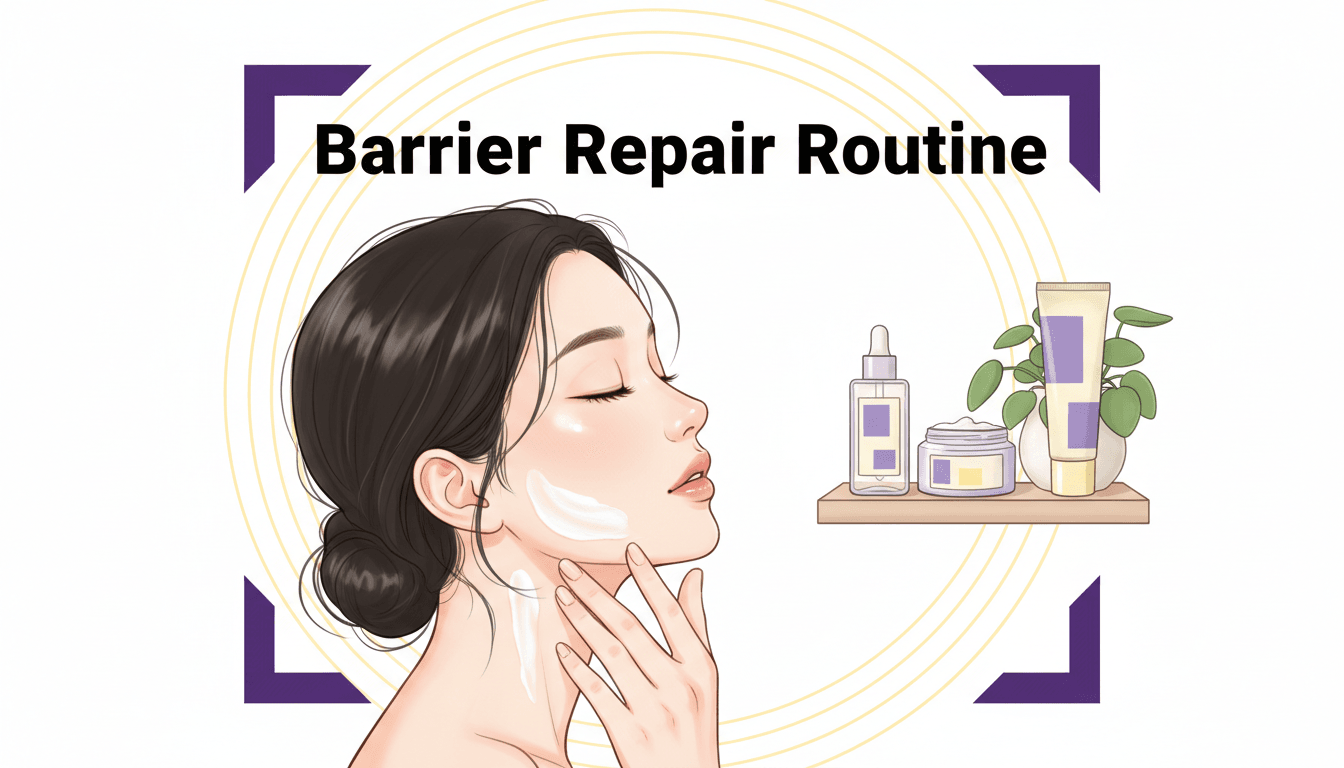
If your skin has started reacting to things it used to tolerate, the fastest way back isn't another active ingredient. It's a short pull-back-and-rebuild period.
For two to four weeks, set aside exfoliating acids and retinoids. Replace your routine with four things only: a gentle, non-foaming cleanser, a humectant like glycerin or hyaluronic acid to draw water in, a moisturizer that lists ceramides, cholesterol, and fatty acids together (not ceramides alone), and a mineral sunscreen every morning.
K-beauty barrier creams tend to do this well, since many are formulated around ceramide-cholesterol-fatty acid complexes rather than a single hero ingredient. Illiyoon, Round Lab, and Dr. Ceuracle all make barrier-focused moisturizers built around this idea, and they're worth a look if your current cream lists ceramides but nothing else from that trio.
When you check a label, you're looking for the three lipids named together, not just ceramide in the first few ingredients. A cream that lists ceramide NP alongside cholesterol and a fatty acid such as linoleic or oleic acid is doing more for your barrier than one that leads with ceramide and fills the rest with fragrance or actives.
Once your skin stops reacting, the redness fades, and the tightness eases, reintroduce your actives one at a time, a few days apart, so you can tell what your skin can handle now, not what it could handle five years ago. |
|
💎 The Glow |
Your skin isn't failing you. It's asking for a different formula than it needed a decade ago.
That's not a flaw. It's just a stage, and the routine that meets it well is smaller and steadier than the one you're used to, not bigger.
Give the pull-back-and-rebuild period its full two to four weeks before judging the results. Barrier repair is slow, unglamorous work, and it rarely shows up in the first few days.
If this was useful, forward it to a friend who's also noticing her routine doesn't behave the way it used to. |
|
Trivia Answer |
False. A moisturizer with ceramides alone is generally not enough to fully repair a damaged skin barrier. Evidence shows that effective barrier repair requires a combination of: Ceramides Cholesterol Free fatty acids Ideally in proportions similar to the skin’s natural lipid structure. Ceramides are crucial, but they’re only one piece of the barrier puzzle. |
|
|